Farmall Cub Tractor Serial Numbers: Unlocking Your Tractor's History
Ever wondered about the story hidden within your Farmall Cub's serial number? More than just a random string of characters, it's a key to unlocking your tractor's past—its manufacturing year, unique features, and place in agricultural history. This guide provides a step-by-step approach to decoding this information, even for those unfamiliar with tractor mechanics. For other tractor serial numbers, check out this helpful resource: tractor serial number info.
The Farmall Cub's Three Eras: A Timeline in Numbers
The iconic Farmall Cub, a workhorse on farms from 1947 to 1979, evolved through three distinct phases, each with its unique serial number system:
- The Original Farmall Cub (1947-1952): The first generation, establishing the Cub's legacy.
- The International Cub (1953-1962): Design improvements showcased advancements in engineering.
- The New International Cub (1963-1979): Modernizations kept the Cub competitive in a changing agricultural landscape.
Knowing your Cub's era is crucial for accurate serial number interpretation. This is like knowing which edition of a classic book you own—it dictates which version of the code you're deciphering.
Decoding Your Cub's Past: A Step-by-Step Guide
Ready to become a tractor detective? Follow these steps to unlock your Farmall Cub's secrets:
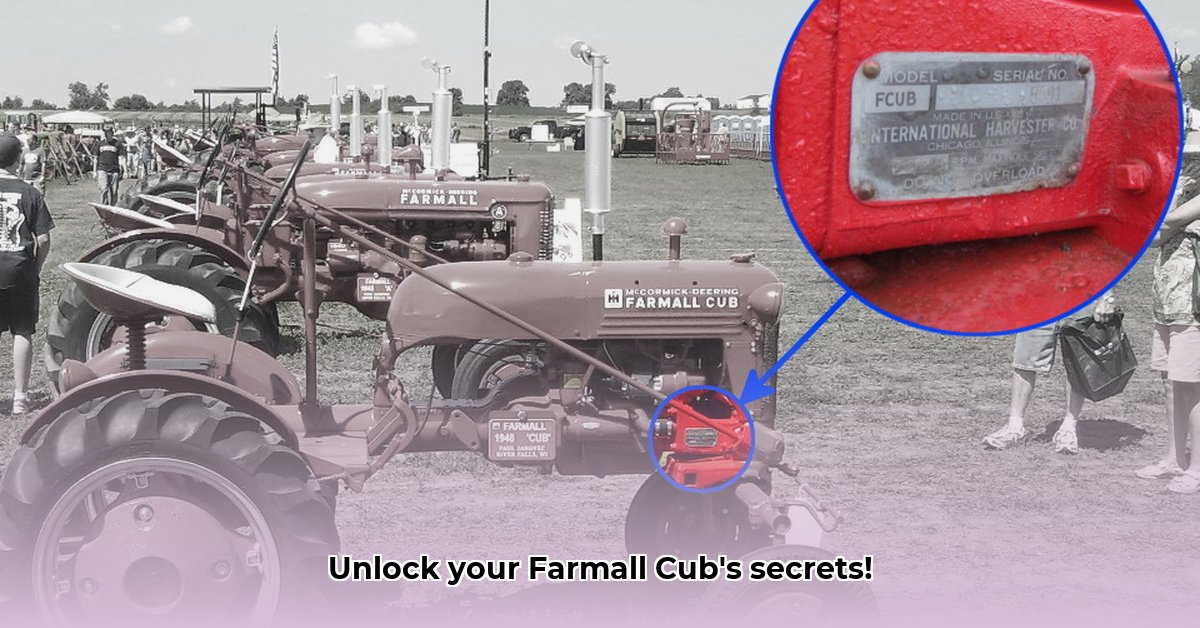
Locate the Serial Number Plate: Carefully search your tractor's frame, often near the steering column. Use a flashlight if needed. A misplaced or hidden plate is the most common first hurdle.
Record the Serial Number: Meticulously write down every digit and letter. Accuracy is paramount—a single incorrect character can lead to significant errors in dating. Double-check your transcription.
Utilize Online Resources: Many online databases and enthusiast communities offer serial number charts correlating number ranges to specific years and sometimes to model variations. These are invaluable resources. Think of these online databases as specialized dictionaries for decoding your tractor's "language."
Match Serial Number to Era: Use the serial number and online resources to determine your Cub’s era (Original, International, or New International). This step is crucial for accurate dating since each era has its own serial number ranges.
Cross-Reference with Physical Inspection: Once you have a potential year, compare your tractor's physical features (engine type, PTO horsepower) to known specifications for that year. This helps verify your initial findings. This is like confirming a historical fact with multiple sources.
Examine Casting Numbers: Casting numbers, found on various engine and chassis parts (e.g., engine block, transmission case), provide additional dating clues. These are less precise but valuable corroborating data.
Beyond the Numbers: Understanding Variations
Your Cub's serial number doesn't just indicate its age. It can also hint at variations in its components, such as engine type or PTO horsepower. This granular information is critical for parts sourcing and restoration. It's the equivalent of confirming a vintage car's engine details—essential for authenticity and repair.
Addressing Missing Serial Numbers: Casting Numbers as Clues
If the main serial number plate is missing or damaged, casting numbers become even more essential. While less precise than the primary serial number, they offer estimates of the manufacturing date. However, remember these are not a replacement but a fallback solution.
The Limits of Interpretation: Acknowledging Uncertainties
Despite detailed records, some uncertainty is possible. Factory records may be incomplete, and delays between manufacturing and delivery are common. The serial number indicates the build date, not necessarily the sale date.
Illustrative Serial Number Ranges (Approximate—Consult Dedicated Charts for Precision)
(Note: These are approximate ranges. Always use dedicated Farmall Cub serial number charts for accurate dating.)
| Era | Approximate Serial Number Range | Likely Year Range |
|---|---|---|
| Farmall Cub | 10000 - 50000 | 1947-1952 |
| International Cub | 50001 - 150000 | 1953-1962 |
| New International Cub | 150001 - 300000 | 1963-1979 |
The Ongoing Quest: Continuous Research
Research into Farmall Cub serial numbers is ongoing; new discoveries and refinements will likely occur. Stay updated on latest findings to enhance your understanding. This is a testament to the enduring interest in these iconic tractors.
Your Farmall Cub's serial number is more than just numbers; it's a piece of history, connecting you to the legacy of this enduring machine. Happy decoding!